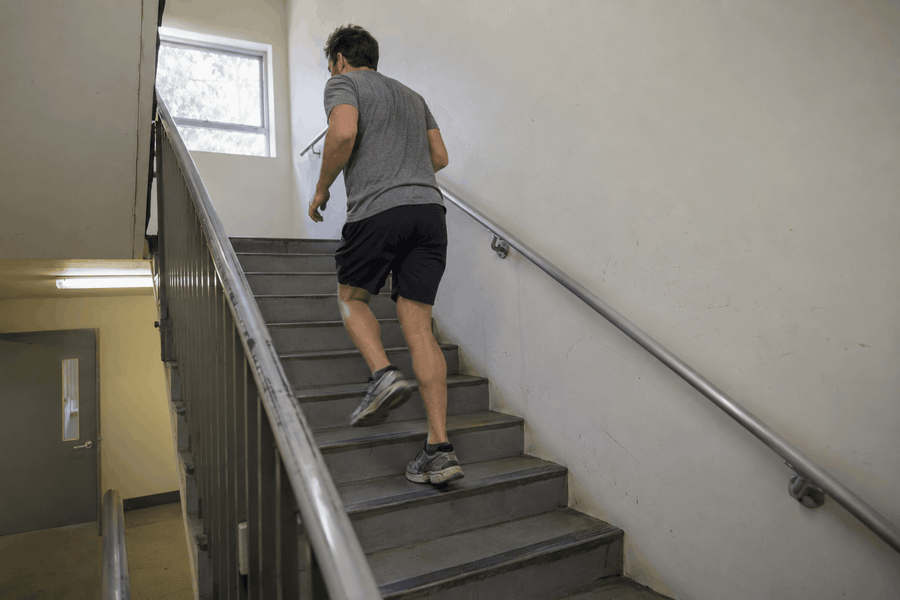
Exercise snacks are short, purposeful bursts of movement completed across the day. They can last from less than a minute to around ten minutes and may involve stair climbing, brisk walking, squats, push-ups or resistance-band exercises.
The idea is useful because it removes one of the biggest practical barriers to exercise: finding a large, uninterrupted block of time. Early research suggests that well-chosen exercise snacks can improve specific measures of fitness. However, the evidence is still developing, and a few short bouts cannot automatically replace everything provided by a complete training program.
What Counts as an Exercise Snack?
An exercise snack is more deliberate than simply standing up or walking to another room. It is a brief bout of activity designed to create a clear physical challenge. The exact challenge depends on the exercise.
A vigorous stair climb quickly increases breathing and heart rate. A short bodyweight circuit places repeated tension on the muscles. Both sessions are brief, but they target different parts of fitness.
Exercise snacks are usually:
- Short: often between one and ten minutes
- Simple: requiring little equipment or preparation
- Repeatable: performed several times across a day or week
- Purposeful: challenging enough to create a training stimulus
The word “snack” can make the approach sound effortless, but the activity still needs to match the intended result. A relaxed walk may be a useful movement break, while a vigorous stair climb creates a different cardiovascular demand. In the same way, several comfortable squats are not the same stimulus as a controlled set completed close to the point where another good repetition would be difficult.
Why Short Bouts May Still Matter
Your body responds to the demand created by an activity, not whether it happened in a gym or lasted exactly 30 minutes. Short bouts can raise your heart rate, challenge working muscles and accumulate meaningful work across a day.
Breaking activity into smaller sessions can also make consistency easier. A person who repeatedly misses a planned hour-long workout may find it more realistic to complete a stair climb in the morning and a short strength circuit later in the day.
That does not mean duration is irrelevant. Longer sessions allow more total work, more exercise variety and more time to develop specific skills. Exercise snacks are best viewed as another way to organise movement, especially when time, access or motivation makes a conventional session difficult.
What Did the Two Studies Find?
Brief stair climbing and cardiorespiratory fitness
A 2019 study randomly assigned 24 sedentary young adults to a stair-climbing group or a non-training control group. The exercise group vigorously climbed a three-flight stairwell containing 60 steps. They completed three separate climbs per day, with one to four hours between each bout, on three days per week for six weeks.
Peak oxygen uptake was higher in the stair-climbing group after the intervention. The researchers concluded that stair-climbing exercise snacks improved cardiorespiratory fitness, although the absolute increase was modest.[1]
This is encouraging because the protocol required no gym and each individual effort was brief. It does not prove that every short activity produces the same result. The sample was small, the participants were sedentary young adults and the protocol involved vigorous stair climbing rather than casual movement.
Resistance exercise snacks and muscle mass
A 2024 pilot study examined women with sedentary occupations who were completing resistance training fewer than two days per week. Participants selected either a control group or an intervention group. The intervention group completed ten minutes of resistance exercise on each working day for 12 weeks.
Twelve people in the intervention group and 14 in the control group completed the study. Average muscle mass increased by 0.42 kilograms in the intervention group and decreased by 0.16 kilograms in the control group. The difference in change between the groups was statistically significant. However, maximum isometric strength did not change significantly between groups, and no significant between-group changes were found for the exploratory outcomes.[2]
The finding suggests that frequent, brief resistance sessions may help some inactive adults accumulate enough training to influence muscle mass. It should still be interpreted cautiously. The study was small, participants were not randomly assigned, the groups differed in some baseline measures, nutrition was not controlled and body composition was assessed using bioelectrical impedance analysis.[2]

Cardio and Strength Snacks Are Not the Same
The two studies used very different forms of exercise. This matters when choosing your own routine.
Cardio-focused snacks aim to increase breathing and heart rate. Examples include a brisk stair climb, a short uphill walk, fast step-ups or a brief cycling effort. The intensity should be appropriate for your current fitness and the environment.
Strength-focused snacks aim to challenge particular muscles. Examples include squats to a chair, wall or bench push-ups, split squats, calf raises and band rows. Control, range of motion and increasing difficulty over time matter more than rushing through repetitions.
You can use both types across the week, but each session should have a clear purpose. Trying to turn every movement break into an exhausting full-body workout can make the habit harder to maintain.
How to Build a Practical Exercise-Snack Routine
Start with a routine that is easy to remember and realistic in your setting. The goal is to remove friction without making the exercise meaningless.
- Choose one reliable trigger. Link the session to something that already happens, such as making coffee, finishing a meeting or arriving home.
- Select one training goal. Decide whether the snack is intended to raise your heart rate, challenge your legs, train your upper body or simply interrupt a long period of inactivity.
- Keep the exercise simple. Choose movements you can perform safely without a long warm-up, complicated setup or specialist equipment.
- Begin with one or two bouts. A routine you repeat is more useful than an ambitious plan you abandon after several days.
- Record one useful measure. Track the number of controlled repetitions, flights climbed, resistance used or session duration.
A simple cardio option
Walk briskly up a manageable flight or set of stairs, then recover fully. Begin with one bout and assess how you feel. The published stair-climbing protocol used vigorous efforts, but it was conducted with screened study participants. You do not need to copy its intensity or volume on your first attempt.
A simple resistance option
Choose two or three movements that cover different areas of the body. For example:
- Eight to fifteen controlled squats to a chair
- Six to twelve wall, bench or floor push-ups
- Eight to fifteen resistance-band rows
Complete one controlled round and stop before technique deteriorates. The exact repetitions should reflect the difficulty of the exercise and your current capacity.
How to Progress Without Turning It Into a Full Workout
Progression gives your body a reason to continue adapting. It does not require making every session longer.
You can gradually increase one variable at a time:
- Add a small number of repetitions
- Use a slightly harder exercise variation
- Increase resistance
- Add another flight of stairs
- Add one extra session on selected days
Change one variable, then give yourself time to adapt. If the routine begins interfering with your normal training, work performance or recovery, reduce the frequency or difficulty.
What Exercise Snacks Cannot Replace
The two studies support specific conclusions, not a promise that tiny workouts produce every possible exercise benefit. The stair-climbing study found a modest improvement in cardiorespiratory fitness in a small group of sedentary young adults.[1] The resistance study found a difference in muscle-mass change, but not a significant difference in strength, in a small non-randomised workplace sample.[2]
A complete training program can provide greater weekly volume, balanced exercise selection, technique development and specific preparation for sport or performance goals. Exercise snacks may complement that program or provide a practical starting point when the alternative is doing nothing.
People with cardiovascular concerns, significant joint pain, balance problems, an injury, pregnancy-related considerations or a condition that affects exercise tolerance should seek appropriate professional guidance before attempting vigorous stair climbing or unfamiliar resistance exercise. Stop if you experience chest pain, faintness or unusual shortness of breath.
The Takeaway
Exercise snacks can make purposeful movement easier to fit into a busy day. The two studies used in this article suggest that brief stair climbing may improve cardiorespiratory fitness and short workplace resistance sessions may support muscle mass in specific inactive populations. Both studies were small, so their results should be treated as promising rather than definitive.
Start with one simple activity, connect it to a reliable point in your day and progress gradually. For more practical, evidence-aware guidance across exercise, nutrition and sleep, visit the ProActive Health Articles hub.
Sources
- Jenkins EM, Nairn LN, Skelly LE, Little JP, Gibala MJ. “Do stair climbing exercise ‘snacks’ improve cardiorespiratory fitness?” Applied Physiology, Nutrition, and Metabolism. 2019;44(6):681–684. View on PubMed.
- Brandt T, Schwandner CTL, Schmidt A. “Resistance exercise snacks improve muscle mass in female university employees: a prospective, controlled, intervention pilot-study.” Frontiers in Public Health. 2024;12:1347825. View the journal article.