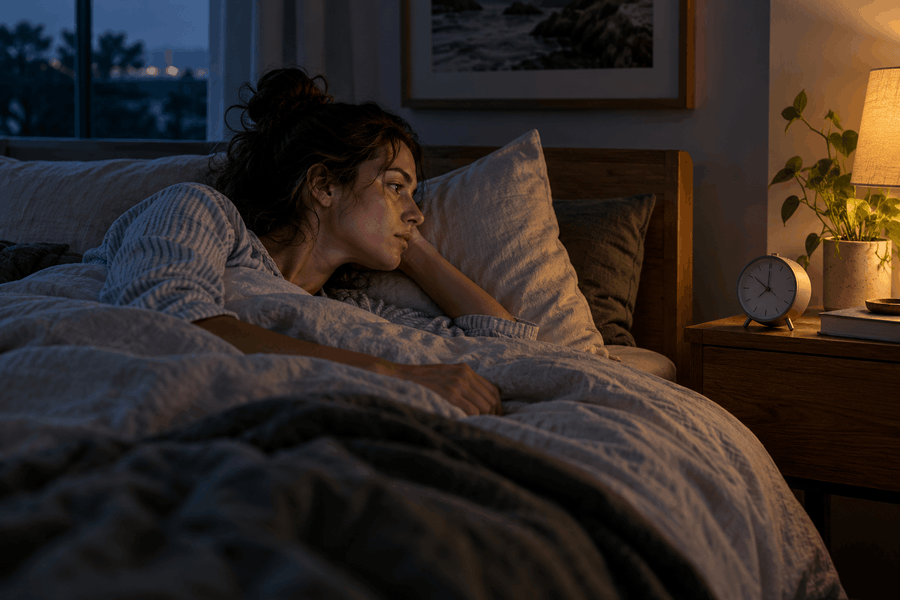
Reading before bed may help some people feel that they sleep better. It is a reasonable habit to try if you enjoy books, provided it fits before your usual bedtime. The research is encouraging, but it does not establish bedtime reading as a reliable solution for everyone.[1]
A useful starting point is a paper book, a comfortable reading light and permission to stop whenever you feel sleepy. Keep the routine easy to repeat, without giving yourself a chapter target or a new task to complete.
What the bedtime reading trial found
In a 2021 online randomised trial, Finucane and colleagues assigned 991 adults to read in bed for 15 to 30 minutes before sleep or avoid bedtime reading for seven nights. Among those who supplied follow-up results, 42% in the reading group reported improved sleep, compared with 28% in the comparison group.[1]
That is a difference of 14 percentage points in the proportion reporting improvement. It does not mean participants slept 14% longer. The study measured how people rated their sleep, rather than recording sleep stages in a laboratory.[1]
There were important limits. Participants knew which group they were in, roughly 22% did not complete follow-up and the trial lasted only a week. Daytime sleepiness was also slightly higher in the reading group. These findings support a cautious personal experiment, rather than a promise of better sleep.[1]
Why choose a paper book for your first attempt?
A printed book offers a straightforward way to separate reading from messages, work and other apps. You can leave your phone elsewhere and choose a clear stopping point. Those are practical reasons to try paper, even if digital reading is your usual preference.
A separate study by Chang and colleagues, published in a 2015 issue of PNAS, compared printed books with a light-emitting tablet. Twelve healthy young adults completed both conditions, reading for about four hours before bed on five consecutive evenings per condition. The tablet was set to maximum brightness.[2]
After tablet reading, participants took longer to fall asleep, had suppressed evening melatonin, a later body clock and reduced alertness the next morning compared with printed-book reading.[2]
This was a small laboratory experiment with prolonged screen exposure. It does not establish that a brief reading session on every modern device has the same effect. It also cannot rank all e-readers, brightness settings or display technologies. A paper book is a simple starting option, rather than a requirement to replace a device you enjoy.[2]
Choose reading you can comfortably put down
There is no need to find a special sleep book. Start with something you already enjoy and notice whether it suits that part of your evening. You might prefer a familiar novel, a short essay, a biography or a collection of stories.
Neither study identifies a best genre for sleep. Treat the choice as a personal preference. If a gripping plot leaves you negotiating for another chapter, save that book for another time and choose something easier to pause.
The same applies to work material. You may find it useful to keep professional reading separate from your bedtime book, especially if it prompts you to write emails or plan tomorrow. The question is whether this particular activity feels like a comfortable end to your day.
Try leaving a bookmark within reach. Stopping halfway through a chapter is completely acceptable. Your book will still be there tomorrow.
Build a reading routine around your bedtime
Give reading its own short window
For a simple trial, set aside 15 to 30 minutes before the time you usually intend to switch the light off. If you plan to sleep at 10 pm, you could begin at 9.30 or 9.45 pm. Adjust the example to your own evening rather than adopting a particular bedtime.
Protect the stopping point. Adding reading after your planned bedtime changes the experiment into staying up later. If you are already sleepy when you pick up the book, you do not need to complete the full reading window.
Make the setup comfortable
Choose a position where your back and arms feel supported. Keep enough light on the page to read comfortably, and move the lamp if you are squinting or dealing with glare. There is no special lamp, pillow or accessory required for this routine.
Reading in bed is optional. A nearby chair may suit you better if sitting under the covers leaves you feeling alert or uncomfortable. Pick the location that makes it easiest to close the book and finish your evening.
Decide what happens after the last page
Before you begin, settle any small practical tasks that might otherwise interrupt the transition. Put your water nearby, arrange the bedding and leave somewhere to place the book. When you finish reading, avoid automatically replacing it with another activity on your phone.
Try a week, then decide whether to keep it
You do not need to turn this into a detailed tracking project. Make a brief note the following morning if that helps you judge the routine. Keep your observations broad enough that one difficult night does not decide the outcome.
- Did you enjoy the reading time?
- Did you stop near your intended bedtime?
- Did winding down feel easier, unchanged or harder?
- How rested and sleepy did you feel the next day?
Note obvious interruptions, such as an unusually late night, without trying to explain every variation. A personal trial cannot prove that reading caused a change. It can help you decide whether the habit is pleasant and practical enough to keep.
If reading repeatedly pushes bedtime later, shorten the window or move it earlier. If you dislike the activity, there is no reason to force it simply because it has been studied.
When reading is not enough
These two studies do not establish bedtime reading as a treatment for persistent insomnia or other sleep disorders. If difficulty sleeping continues, affects your daytime functioning or comes with concerns such as breathing pauses, speak with a GP rather than relying on a reading routine alone.
You can also explore our guide to what to do when you cannot fall asleep, or browse more practical topics in the ProActive Health Articles hub.
The takeaway
A bedtime book can be a pleasant way to finish your evening. Try a short reading window, choose something you can put down and leave enough time for sleep. Keep the habit if it suits you, and adjust it if it becomes another reason to stay awake.
Sources
- Finucane E, et al. Does reading a book in bed make a difference to sleep in comparison to not reading a book in bed? The People's Trial—an online, pragmatic, randomised trial. Trials. 2021;22:873. Read the study on PubMed.
- Chang AM, Aeschbach D, Duffy JF, Czeisler CA. Evening use of light-emitting eReaders negatively affects sleep, circadian timing, and next-morning alertness. Proceedings of the National Academy of Sciences. 2015;112(4):1232–1237. Read the study on PubMed.