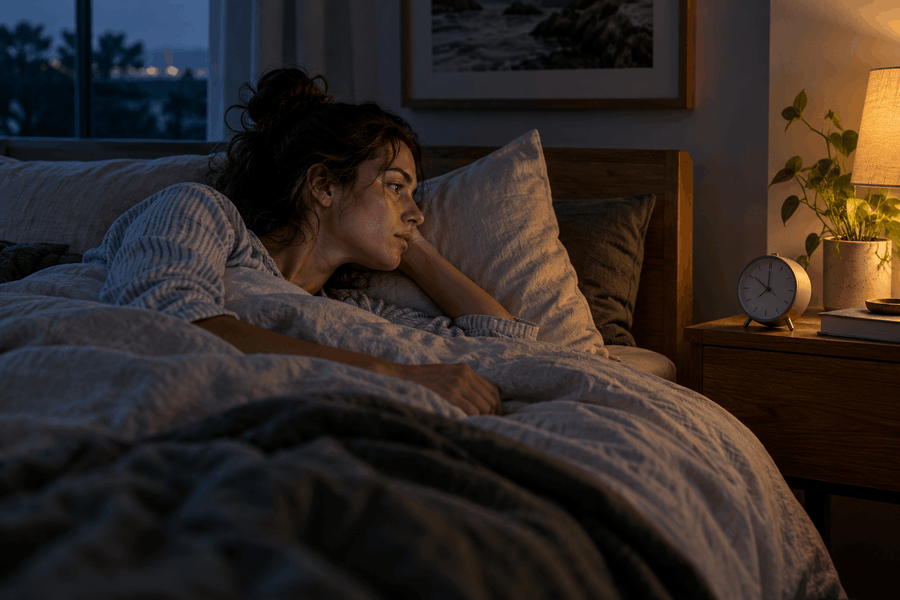
Nearly nine in ten people (87 percent) say they use their phone or tablet within the hour before bed, according to a 2022 YouGov sleep study. What seems like harmless scrolling may actually be disrupting your sleep. Blue light from digital screens interferes with your body's natural sleep rhythm and suppresses melatonin, the hormone that helps you fall asleep.
Understanding how blue light affects sleep is essential for anyone looking to improve their energy, clarity, and long-term wellbeing.
What Is Blue Light and Why Is It Important
Blue light is a short-wavelength, high-energy visible light found naturally in sunlight and also emitted by electronic devices and LED lighting. Exposure during the day helps with alertness and mood. However, when exposure continues into the evening, it signals to the brain that it is still daytime. This delays melatonin release and disrupts the circadian rhythm.
A study published in the Journal of Biological Rhythms found that tuning the spectral qualities of light could reduce melatonin suppression without changing the brightness or colour temperature. This highlights how sensitive our body clock is to evening light, especially in the blue spectrum.
How Blue Light Suppresses Melatonin
Specialised cells in the eye known as intrinsically photosensitive retinal ganglion cells are especially responsive to blue light. These cells send signals to the brain’s master clock, located in the suprachiasmatic nucleus. This process regulates melatonin release and sleep timing.
An experiment from Harvard Medical School compared people reading on a light-emitting eReader to those reading a printed book before bed. Those using the eReader experienced a 90-minute delay in melatonin release, took longer to fall asleep, and reported lower alertness the following morning. This demonstrates how artificial evening light from screens can impair both sleep quality and next-day function.
In-Depth: Blue Light and Its Effect on Teenagers
Teenagers are especially vulnerable. Adolescents already experience a delayed circadian rhythm due to natural hormonal changes. When combined with device use in the evening, the effects can be even more disruptive.
A review in Sleep Medicine Reviews found that evening screen time was consistently associated with later bedtimes and reduced total sleep in adolescents. Another study showed that children aged nine to fourteen experienced stronger melatonin suppression from evening light compared to adults. This suggests they are more biologically sensitive to artificial light at night.
These disruptions are not just about sleep. Poor sleep in teenagers is linked to reduced academic performance, higher rates of anxiety and depression, and impaired emotional regulation.
In-Depth: Metabolic and Hormonal Effects of Evening Blue Light
Sleep disruption does not only affect how rested you feel. It can also impact your metabolism and hormones.
A study in PLOS ONE found that evening exposure to blue-enriched light raised blood glucose peaks and reduced insulin sensitivity, compared to dim light. The participants in the study were healthy adults with no pre-existing conditions, suggesting that even in a healthy population, blue light at night can alter metabolic function.
Research has also shown that disrupted sleep alters hunger hormones such as leptin and ghrelin, which may increase appetite and reduce satiety. Over time, this can contribute to weight gain and higher risk of metabolic disease.
Simple Strategies to Protect Your Sleep
You can take small steps that make a meaningful difference to your sleep quality:
-
Turn off screens at least one to two hours before going to bed
-
Use night mode or blue light filters on your devices
-
Choose relaxing alternatives like reading a physical book or stretching
-
Keep your bedroom screen-free to reinforce its connection with rest
Why Better Sleep Matters for Your Health
Sleep is a pillar of good health. Poor sleep quality is linked to chronic illnesses such as type 2 diabetes, heart disease, obesity, and mood disorders. Even moderate improvements in your sleep environment and evening routines can reduce these risks.
Taking action to reduce evening blue light exposure can lead to better quality sleep, improved mental clarity, and greater energy throughout the day.
Summary
Digital screens are an unavoidable part of modern life. But they do not need to disrupt your health. By understanding the effects of blue light and making small, practical changes to your evening routine, you can support your sleep and protect your long-term wellbeing. Consistent rest is one of the simplest and most powerful ways to feel your best, think clearly, and stay healthy.
References
Chang, A. M., Aeschbach, D., Duffy, J. F., & Czeisler, C. A. (2015). Evening use of light-emitting eReaders negatively affects sleep, circadian timing, and next-morning alertness. Proceedings of the National Academy of Sciences, 112(4), 1232–1237.
https://www.pnas.org/content/112/4/1232
Cheung, I. N., Zee, P. C., Shalman, D., Malkani, R. G., Kang, J., & Reid, K. J. (2016). Morning and evening blue-enriched light exposure alters metabolic function in normal weight adults. PLOS ONE, 11(5), e0155601.
https://journals.plos.org/plosone/article?id=10.1371/journal.pone.0155601
Hale, L., & Guan, S. (2015). Screen time and sleep among school-aged children and adolescents: A systematic literature review. Sleep Medicine Reviews, 21, 50–58.
https://doi.org/10.1016/j.smrv.2014.07.007
Souman, J. L., Borra, T., de Goijer, I., Schlangen, L. J. M., Vlaskamp, B. N. S., & Lucassen, M. P. (2018). Spectral tuning of white light allows for strong reduction in melatonin suppression without changing illumination level or color temperature. Journal of Biological Rhythms, 33(4), 420–431.
https://doi.org/10.1177/0748730418784041
YouGov. (2022). Sleep Study Part Four: Impact of screens and lights.
https://yougov.co.uk/health/articles/42947-yougov-sleep-study-part-four-impact-screens-lights