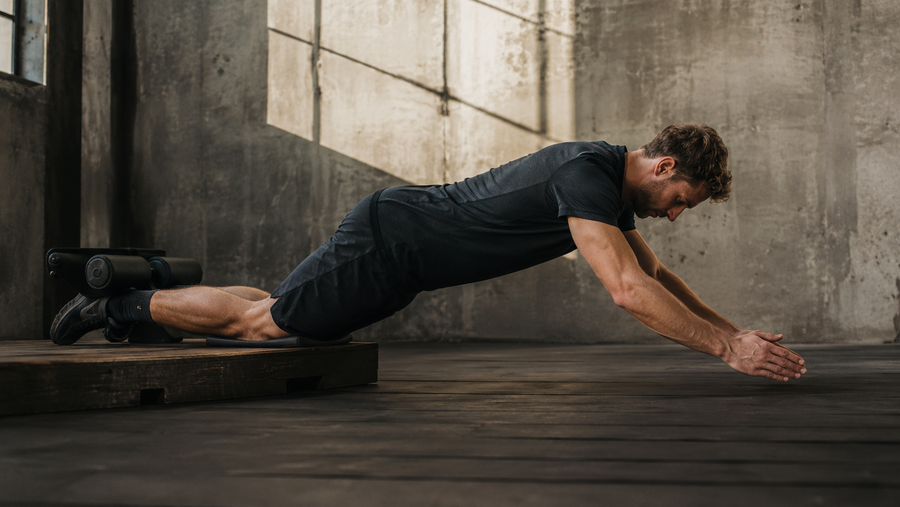
Isometric Holds for Strength: What Science Says and How to Use Them
You do not need to move a muscle to build serious strength. Isometric training, where muscles contract without changing joint position, is emerging as one of the most underused but effective tools for developing force, control, and joint-specific strength.
This static style of training can be done almost anywhere, often with little or no equipment. Yet the physiological adaptations are surprisingly powerful.
Let’s look at what’s happening in your body when you hold, not lift, and how to apply it in your training.
What Are Isometric Holds?
An isometric contraction occurs when a muscle generates tension without changing length. In practical terms, it means holding a position under load, like pausing in a wall sit or pressing against an immovable object.
Unlike traditional dynamic movements, there is no lifting or lowering. Instead, the muscle stays activated in one position, often leading to a deep burn and high levels of recruitment.
Isometric exercises can be performed at various joint angles to target specific points in a lift. This makes them uniquely suited for addressing weak points or improving force output in a controlled and joint-friendly way.
How Isometric Training Builds Strength
One of the key benefits of isometric training is its ability to increase angle-specific strength. A 2025 study comparing isometric and dynamic resistance training found that both improved strength, but isometric holds produced greater force at the specific joint angles trained.
This happens because isometric contractions recruit high-threshold motor units, which are responsible for generating maximal force. When you hold a difficult position under tension — like pushing against a fixed bar or holding a paused squat — you train the nervous system to fire more efficiently.
A separate 12-week study in young adults found that short-duration isometric training led to improvements in tendon stiffness, neuromuscular function, and muscle control. These changes occurred with relatively brief training sessions, as long as the intensity of the hold was high enough.
Because you’re not moving through full ranges, joint stress is often reduced, making this approach useful for athletes managing injuries or older adults with movement restrictions.
How to Use Isometric Holds in Training
The key to effective isometric training is high muscular effort, even without movement. You can use your own bodyweight, resistance bands, or even a fixed surface to push or pull against.
Here are a few guidelines:
Choose strategic positions
Focus on joint angles where you typically struggle — like the bottom of a squat or mid-range of a bench press. Holding at these points builds strength right where you need it most.
Use high tension
Effort matters more than load. Aim for around 70% or more of your maximum effort. The contraction should feel challenging and sustain tension for 10 to 30 seconds.
Train multiple angles
Because strength gains are mostly limited to the angles trained, using a few different hold positions across your sessions ensures more well-rounded development.
Pair with dynamic movement
Isometrics are excellent for building force, but they don’t replace full-range movement. Combine them with dynamic lifts to train both mobility and strength.
Allow recovery
These contractions tax the nervous system. Like heavy lifting, they require adequate rest between sessions and sets.
When to Use Isometric Training
Isometric holds can be especially useful in the following cases:
-
Injury rehab — where movement is limited but strength must be maintained
-
Breaking plateaus — targeting sticking points in compound lifts
-
Tendon health — loading connective tissue in a controlled, gradual way
-
Time-constrained sessions — fast, effective training with minimal setup
-
Joint-sensitive individuals — building strength without heavy movement
They are also useful in sports and martial arts, where static strength and postural control are critical.
Why It Matters
Isometric training builds more than muscle. It strengthens the connection between your nervous system and your muscles, improves control, and targets precise points of weakness. For many people, it also reduces strain on joints, supports tendon resilience, and allows training when traditional lifts are off the table.
You don’t always need movement to make progress. Sometimes, holding still is the most powerful thing you can do.